
Hitzewelle löst in ganz Europa große Waldbrände aus; 10.000 Menschen in Frankreich evakuiert, während die Feuerwehr unter extremen Bedingungen kämpft
Vielen Dank, dass Sie sich für Automatic Translation entschieden haben. Derzeit bieten wir Übersetzungen aus dem Englischen ins Französische und Deutsche an, weitere Sprachen werden in naher Zukunft hinzukommen. Bitte beachten Sie, dass diese Übersetzungen von einem KI-Softwaredienst eines Drittanbieters erstellt werden. Wir haben festgestellt, dass die Übersetzungen größtenteils korrekt sind, aber nicht in jedem Fall perfekt. Um sicherzustellen, dass die Informationen, die Sie lesen, korrekt sind, lesen Sie bitte den Originalartikel auf Englisch. Wenn Sie einen Fehler in einer Übersetzung finden, auf den Sie uns aufmerksam machen möchten, wäre es sehr hilfreich, wenn Sie uns dies mitteilen würden. Wir können jeden Text oder Abschnitt korrigieren, sobald wir davon Kenntnis haben. Bitte zögern Sie nicht, unseren Webmaster zu kontaktieren, um uns auf Übersetzungsfehler hinzuweisen.
6. Juli 2026 – Europa. Eine schwere Hitzewelle, die über Südeuropa hinwegfegt, hat in Frankreich, Spanien und Griechenland zahlreiche große Waldbrände ausgelöst, die zu Massenevakuierungen geführt und die Ressourcen der Feuerwehren in der gesamten Region bis an ihre Grenzen belastet haben. Wetterdienste melden Temperaturen, die deutlich über den saisonalen Durchschnittswerten liegen, wobei anhaltende Dürrebedingungen in mehreren Ländern zu einem explosiven Brandverhalten führen.
Bildnachweis:
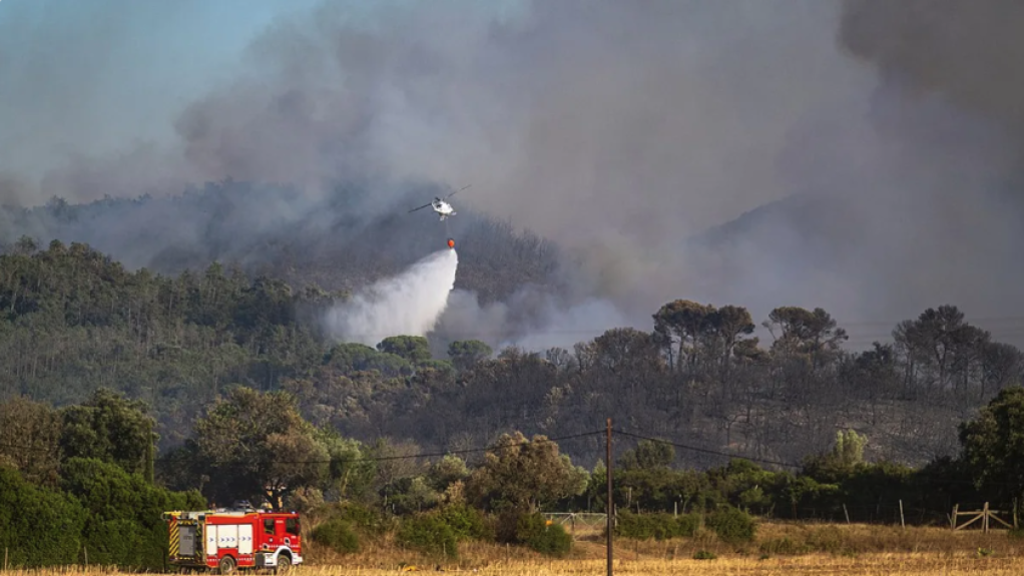
Ein Löschhubschrauber bekämpft die Flammen im Gebirgszug Les Gavarres in Katalonien, während Feuerwehrleute am Boden für Sicherheit sorgen./ Foto: Soziale Medien
In Frankreich evakuierten die Behörden 10.000 Einwohner, nachdem am Samstag in der Nähe von Trévillach in der Region Pyrénées-Orientales, nahe der spanischen Grenze, ein sich schnell ausbreitender Waldbrand ausgebrochen war. Laut lokalen Behörden führten starke Winde und außergewöhnlich trockene Vegetation zu einer raschen Ausbreitung des Feuers, was einen großangelegten Einsatz mit Hunderten von Feuerwehrleuten, Löschflugzeugen und einer grenzüberschreitenden Koordination mit den katalanischen Rettungsdiensten erforderlich machte.
CBC berichtet, dass sich das Feuer durch bewaldetes Gelände und ländliche Gemeinden ausbreitete und die Bewohner zur Flucht zwang, als über dem Tal Rauchsäulen sichtbar wurden. Es wurden keine Todesopfer gemeldet, doch vermutlich sind mehrere Gebäude beschädigt, und die Behörden warnen, dass die Eindämmungsmaßnahmen Tage dauern könnten.
Der Vorfall in Frankreich ist Teil eines europaweiten Trends. ABC News berichtet, dass auch Spanien und Griechenland mit erheblichen Waldbränden zu kämpfen haben, wobei die Rettungskräfte mit extrem hohen Flammen, unberechenbaren Winden und schwieriger Topografie konfrontiert sind. In Spanien sind mehrere Brände in Katalonien und Aragón ausgebrochen, während griechische Feuerwehrleute Brände auf dem Festland und auf mehreren Inseln bekämpfen.
In vielen Gebieten über 40 °C
Eine meteorologische Analyse zeigt, dass sich die anhaltende Hitzewelle – mit Temperaturen von über 40 °C in Teilen Südeuropas – im Laufe der Woche voraussichtlich noch verstärken wird. Die Brandwetterindizes bleiben in weiten Teilen auf einem „sehr hohen“ bis „extremen“ Niveau, was Besorgnis über weitere Brandausbrüche weckt und die Einsatzbedingungen für die Löschmannschaften erschwert.
Europäische Feuerwehrbehörden fordern die Bevölkerung dringend auf, Evakuierungsanordnungen zu befolgen, brandgefährdete Gebiete zu meiden und angesichts der sich rasch ändernden Lage wachsam zu bleiben. Da ein weiterer Temperaturanstieg prognostiziert wird, bereiten sich die Rettungsdienste auf dem gesamten Kontinent auf eine der möglicherweise schwersten Waldbrandperioden der letzten Jahre vor.
20.000 Todesfälle aufgrund von hitzebedingten Problemen
„Sepaske Novine“ berichtet, dass eine vorläufige Studie die Zahl der überdurchschnittlichen Todesfälle in ganz Europa während der Hitzewelle im Juni auf rund 20.400 schätzt, während Waldbrände in der Nähe von Girona und im Norden Portugals Tausende Hektar Land verschlingen und Menschen aus ihren Häusern vertreiben.
Mehreren internationalen Behörden zufolge sind die Temperaturen auf über 40–45 °C gestiegen, was zu extremen Brandbedingungen geführt und die Rettungsdienste überfordert hat.
Waldbrände haben bereits mehr als 190 Quadratkilometer Land in Portugal, Spanien, Frankreich und Griechenland verwüstet und Tausende von Anwohnern zur Flucht aus ihren Häusern gezwungen, während Feuerwehrleute unter intensiver Hitze und trockenen Winden gegen sich schnell ausbreitende Feuerkessel kämpfen.
Die Hitzewelle im Juni, die den aktuellen Bränden vorausging, führte zu Tausenden von zusätzlichen Todesfällen – ein Ereignis, das laut Wissenschaftlern ohne den Klimawandel „praktisch unmöglich“ gewesen wäre.
In Spanien und Portugal gelten weiterhin flächendeckend Hitzewarnungen der Stufe Rot mit Temperaturen von 43–45 °C, was die Löscharbeiten erschwert und die Befürchtung weiterer Brandausbrüche schürt.
Bildnachweis: Ein Löschhubschrauber bekämpft die Flammen im Gebirgszug Les Gavarres in Katalonien, während Feuerwehrleute am Boden für Sicherheit sorgen./ Foto: Soziale Medien
Weiterführende Informationen:
https://www.cbc.ca/news/world/france-wildfire-evacuation-9.7259522
https://apnews.com/article/8b78a5d051273e24455357da63551fef
https://www.reuters.com/business/environment/firefighters-battle-wildfire-south…
https://srpske.rs/en/news/svet/2026/07/06/heatwave-grips-europe-thousands-dead-…
✓ Hitzewellen und übermäßige Sterblichkeit – wissenschaftliche und meteorologische Quellen
Copernicus Climate Change Service (C3S) – Europäische Hitzewellendaten
https://climate.copernicus.eu/
Europäische Umweltagentur – Klima und Hitzewellen-Sterblichkeit
https://www.eea.europa.eu/themes/climate
Weltorganisation für Meteorologie (WMO) – Globale Hitzewellenwarnungen
https://public.wmo.int/en/media/news
Gemeinsame Forschungsstelle der EU (JRC) – Risiko von Hitzewellen und Waldbränden
https://joint-research-centre.ec.europa.eu/
Eurostat – Statistiken zur Übersterblichkeit
https://ec.europa.eu/eurostat/web/main/data/database
Waldbrände in Spanien und Portugal – Offizielle Behörden
Spanien – Ministerio para la Transición Ecológica (MITECO)
Spanien – AEMET (Nationale Wetterbehörde)
https://www.aemet.es/en/portada
Portugal – Autoridade Nacional de Emergência e Proteção Civil (ANEPC)
Portugal – IPMA (Meteorologie und Brandwetter)
Wissenschaftlicher Kontext zur Sterblichkeit bei Hitzewellen
Lancet Countdown – Auswirkungen auf Klima und Gesundheit
https://www.lancetcountdown.org/
Europäisches Zentrum für die Prävention und die Kontrolle von Krankheiten (ECDC)
https://www.ecdc.europa.eu/en/climate-change (ecdc.europa.eu in Bing)
WHO Europa – gesundheitliche Auswirkungen von Hitzewellen