
Iceland defines climate change a security threat to their nation as the Atlantic ocean currents show signs of collapse
Thank you for choosing Automatic Translation. Currently we are offering translations from English into French and German, with more translation languages to be added in the near future. Please be aware that these translations are generated by a third party AI software service. While we have found that the translations are mostly correct, they may not be perfect in every case. To ensure the information you read is correct, please refer to the original article in English. If you find an error in a translation which you would like to bring to our attention, it would help us greatly if you let us know. We can correct any text or section, once we are aware of it. Please do not hesitate to contact our webmaster to let us know of any translation errors.
Iceland has become the first country to declare a climate-related issues as a national security risk, as reported by Reuters and other international media.
Iceland views the potential collapse of a major Atlantic Ocean current system as a national security concern and an existential threat which will enable its government to strategize for worst-case scenarios, according to the country's climate minister.
In a stark warning that reverberated across climate and security circles, Iceland has declared the potential collapse of the Atlantic Meridional Overturning Circulation (AMOC) an “existential threat” and a national security risk.
The AMOC, which includes the Gulf Stream, plays a critical role in regulating climate across the Northern Hemisphere.
It transports warm water from the tropics northward and returns cold water southward, influencing everything from monsoon patterns in Africa to winter temperatures in Europe. A collapse—potentially as early as 2025 according to some models—would disrupt this balance, plunging parts of Europe into deep freezes, intensifying droughts in the Sahel, and destabilizing marine ecosystems.
Iceland’s Prime Minister Katrín Jakobsdóttir emphasized the urgency: “This is not just a climate issue. It’s a matter of national and international security.”
Scientific Alarm Bells
The warning aligns with recent research from the University of Copenhagen, which suggests the AMOC could collapse between 2025 and 2095, with a central estimate around 2057. The study, published in Nature Communications, used statistical analysis of sea surface temperature patterns to predict tipping points. While some scientists caution that the models are uncertain, others argue that the risks are too great to ignore.
The study, led by Peter Ditlevsen and Susanne Ditlevsen, estimates with 95% confidence that the Atlantic Meridional Overturning Circulation (AMOC) could collapse between 2025 and 2095, with the most likely tipping point around 2057. The researchers used advanced statistical methods and 150 years of sea surface temperature data to identify early warning signals of instability in the AMOC system
In a separate investigation, Reuters reported that Icelandic volcanologists are also monitoring increased magma buildup beneath glaciers, possibly linked to climate-driven ice retreat.
Global Implications
A collapse of the AMOC would not be confined to the North Atlantic. It could shift tropical rain belts, disrupt agricultural zones, and accelerate sea level rise along the eastern seaboard of North America. The UK Met Office has warned that such a collapse could reduce rainfall in the Amazon and intensify heatwaves in Europe.
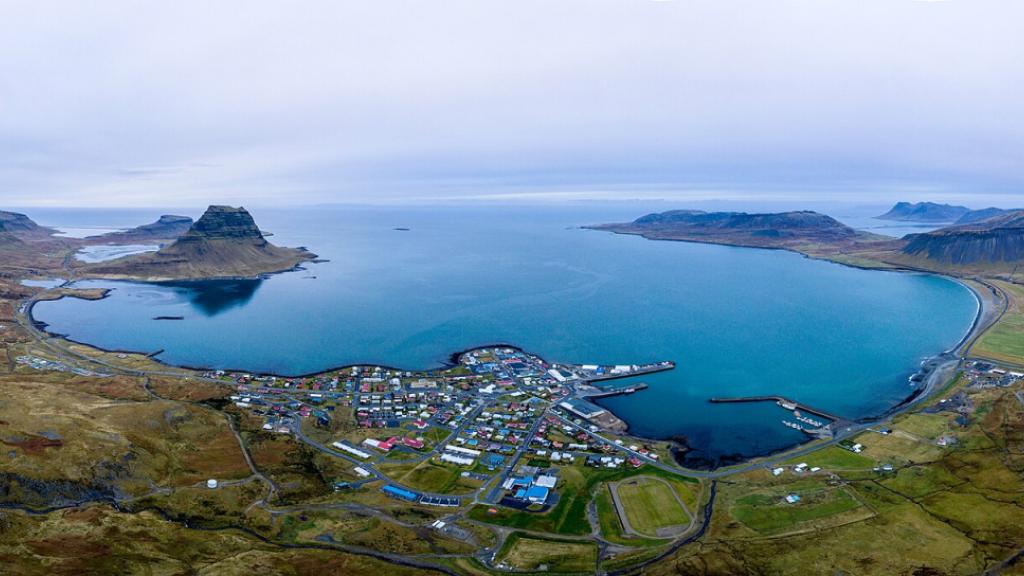
Photo Credit: Wikipedia Creative Commons License

Grundarfjörður, Iceland - Town next to Kirkjufell
Taken on 30 September 2018
Author: Chr Grundo
Camera location
 64° 55′ 00.01″ N, 23° 15′ 31.28″ W
.jpg¶ms=064.916670_N_-023.258688_E_globe:Earth_type:camera_alt:0_source:exif_&language=en)
Read more:
https://www.nature.com/articles/s41467-023-39810-w
https://www.reuters.com/investigates/special-report/climate-change-glacier-volcanoes/