
Toxic fallout lingers after Tehran oil depot fire, echoing wartime environmental damage in Ukraine
Thank you for choosing Automatic Translation. Currently we are offering translations from English into French and German, with more translation languages to be added in the near future. Please be aware that these translations are generated by a third party AI software service. While we have found that the translations are mostly correct, they may not be perfect in every case. To ensure the information you read is correct, please refer to the original article in English. If you find an error in a translation which you would like to bring to our attention, it would help us greatly if you let us know. We can correct any text or section, once we are aware of it. Please do not hesitate to contact our webmaster to let us know of any translation errors.
A major blaze at the Shahran oil depot sent what witnesses described as “toxic black rain” over parts of the Iranian capital. Environmental and public health concerns continue to mount, raising broader questions about the long-term climate and ecological consequences of large-scale fuel fires — whether caused by accident or conflict.
The incident involved prolonged burning of petroleum products, releasing dense plumes of soot, unburned hydrocarbons, and toxic particulates into the atmosphere. Fallout from the smoke column reportedly mixed with precipitation, depositing contaminants across urban areas — a phenomenon sometimes referred to as “black rain.”
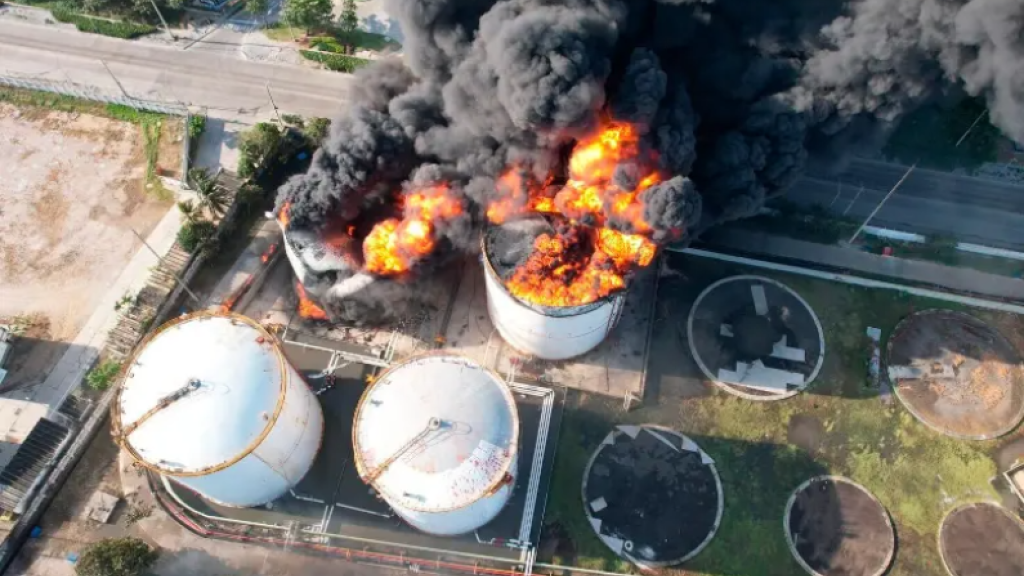
Photo Credit: Wikipedia Creative Commons License

Description: A fuel storage tank fire in Columbia
Date: December 22, 2022
Source: elcolombiano.com/colombia/incendio-en-barranquilla-controlan-llamas-en-un-tanques-de-combustible-que-causo-emergencia-HG19686010
Author: Unknown
Persistent Environmental and Health Effects
Long after the Shahran depot fire has faded from headlines, its environmental legacy may persist for years — much like the scorched landscapes and polluted air seen in conflict zones.
Experts note that such incidents can leave a lingering environmental footprint well beyond the visible fire damage. Oil depot fires release a complex mixture of pollutants, including:
- Black carbon (soot), a potent short-lived climate pollutant that accelerates atmospheric warming
- Polycyclic aromatic hydrocarbons (PAHs), linked to cancer and long-term soil contamination
- Sulfur and nitrogen compounds, contributing to acid rain and respiratory illness
Studies of large hydrocarbon fires show that contamination can persist in soil and groundwater for months or years, particularly in dense urban environments where runoff pathways are limited.
Parallels to Wartime Fires in Ukraine
The Tehran incident mirrors environmental impacts seen during the war in Ukraine, where repeated strikes on fuel depots, refineries, and industrial facilities have triggered similar large-scale fires.
Since 2022, attacks on energy infrastructure in cities such as Kyiv, Kharkiv, and Odesa have led to:
- Massive smoke plumes visible from satellite imagery
- Localized “toxic rain” events following combustion of fuel and industrial chemicals
- Widespread soil and water contamination near strike sites
According to environmental monitoring groups and satellite-based assessments, these fires have released millions of tonnes of CO₂-equivalent emissions, effectively offsetting years of emissions reductions efforts in the region.
War as a Driver of Climate Impact
Researchers increasingly warn that modern warfare is an under-recognized contributor to climate change. The environmental toll stems from several overlapping factors:
- Direct emissions from burning fuel depots, vehicles, and infrastructure
- Indirect emissions from reconstruction, which requires carbon-intensive materials like cement and steel
- Ecosystem destruction, including forest fires and soil degradation
- Military operations, which rely heavily on fossil fuels
Recent analyses suggest that the war in Ukraine alone has generated emissions comparable to those of a mid-sized industrialized country over the same period.
While often overlooked in climate accounting, modern warfare can rival or exceed the emissions of many traditional civilian sources of CO₂. Military activity—from fuel-intensive air operations and armoured vehicles to the destruction and burning of oil depots and infrastructure—produces large, concentrated bursts of greenhouse gases.
Studies of conflicts such as the war in Ukraine suggest total emissions reaching levels comparable to those of entire mid-sized countries, placing war alongside major emitters like the aviation sector or some national industrial economies.
Unlike steady sources such as transportation or power generation, however, wartime emissions are highly episodic but extremely intense, often compounded by post-conflict reconstruction, which requires carbon-heavy materials like cement and steel. As a result, war functions as both an immediate emissions shock and a long-term climate driver, amplifying its impact well beyond the battlefield.
Urban Risk and Civilian Exposure
In both Iran and Ukraine, a key concern is the proximity of such incidents to populated areas. Oil storage facilities and energy infrastructure are often located near cities, increasing the risk that airborne toxins will directly affect civilians.
Public health experts warn that exposure to combustion byproducts — especially in the form of particulate-laden rainfall — can lead to:
- Elevated rates of respiratory illness
- Long-term cancer risks
-
Contamination of drinking water sources
A Growing Global Concern
The Tehran fire underscores a broader global vulnerability: as urban populations grow and energy infrastructure remains concentrated near cities, the consequences of large fuel fires — whether accidental, industrial, or conflict-related — are becoming more severe.
Fire service organizations, including CTIF, have increasingly emphasized the need for:
- Improved risk mapping of fuel storage near urban centers
- Enhanced firefighting capabilities for large-scale hydrocarbon incidents
- International cooperation on environmental monitoring after major fires
Long after the Shahran depot fire has faded from headlines, its environmental legacy may persist for years — much like the scorched landscapes and polluted air seen in conflict zones.
As climate change accelerates, incidents like these highlight a critical intersection between disaster response, urban planning, and global environmental policy: the recognition that fires — whether sparked by accident or war — are not only immediate emergencies, but long-term climate events.
Further Reading:
https://en.wikipedia.org/wiki/Environmental_impact_of_the_Russian_invasion_of_Ukraine?
https://ceobs.org/new-data-reveals-the-military-emissions-gap-is-growing-wider/?
https://time.com/7335449/ukraine-russia-war-climate-impact/?
https://wodnesprawy.pl/en/war-in-ukraine-generated-millions-t-of-co2/?