
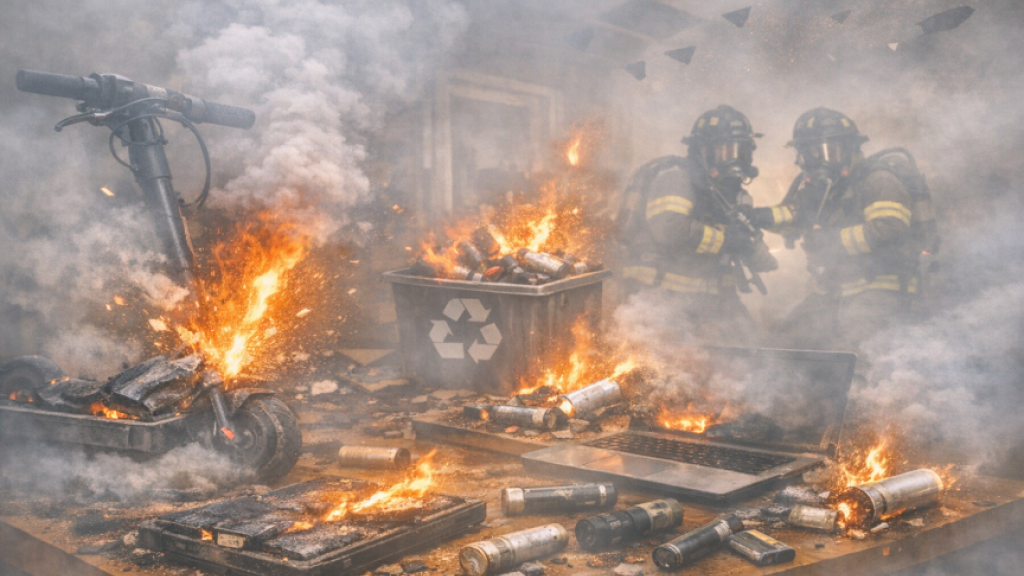
Fire Experts Warn of Escalating Lithium‑Ion Battery Hazards as Incidents Surge Across the UK
Thank you for choosing Automatic Translation. Currently we are offering translations from English into French and German, with more translation languages to be added in the near future. Please be aware that these translations are generated by a third party AI software service. While we have found that the translations are mostly correct, they may not be perfect in every case. To ensure the information you read is correct, please refer to the original article in English. If you find an error in a translation which you would like to bring to our attention, it would help us greatly if you let us know. We can correct any text or section, once we are aware of it. Please do not hesitate to contact our webmaster to let us know of any translation errors.
"It's a new technology that comes with an unintended new hazard, that keeps me awake at night,"
Fire‑safety researchers and emergency‑service leaders across the United Kingdom are sounding the alarm over a rapidly intensifying public‑safety threat: lithium‑ion battery fires.
Once considered a niche technical concern, these incidents have surged sharply in recent years, prompting senior fire scientists to warn that the risks are now outpacing public awareness, regulatory frameworks, and traditional firefighting strategies.
🔥 A Historic Glasgow Blaze Highlights the Growing Danger
A devastating fire that tore through a historic building near Glasgow Central Station—Scotland’s busiest rail interchange—has become a flashpoint in the national conversation. Investigators believe the blaze began in a vape shop, where lithium‑ion batteries were stored and sold. The incident forced the temporary closure of the station and underscored how everyday consumer products can trigger catastrophic events when batteries fail.
📈 Sharp Rise in Battery‑Related Fires
Fire services across the UK report a significant escalation in lithium‑ion battery incidents:
- Scotland: Newly released data shows a steep increase in battery‑related fires across the country.
- London: Firefighters now respond to an e‑bike or e‑scooter fire every other day, a frequency that officials say would have been unthinkable just a few years ago.
These trends are echoed by independent reporting that highlights a “dramatic surge” in battery‑related emergencies, including fires in homes, public spaces, garbage trucks, and recycling facilities.
⚠️ “It Keeps Me Awake at Night”: Experts Describe a New Class of Fire
Two of the UK’s leading fire‑science researchers say lithium‑ion batteries represent a fundamentally different type of hazard:
- Prof. Guillermo Rein, Imperial College London, warns that lithium‑ion battery fires “breach most of the layers of protection that we know,” describing the technology as an “unintended new hazard” that keeps him awake at night.
- Prof. Paul Christensen, University of Newcastle, emphasizes that although the probability of ignition is low, the severity of a lithium‑ion fire is “very, very high.”
Fire officials agree. Richard Field, electrical safety lead for the National Fire Chiefs Council, notes that when these batteries fail, “they can fail catastrophically.”
🔬 What Makes Lithium‑Ion Fires So Dangerous?
Experts point to thermal runaway, a chain reaction in which a damaged or faulty battery overheats uncontrollably:
- Internal temperatures spike rapidly.
- Toxic gases vent under high pressure.
- Flames can erupt like a blowtorch.
- In some cases, the battery may explode.
This behavior makes lithium‑ion fires fast‑moving, extremely hot, and difficult to extinguish, often overwhelming conventional fire‑suppression systems.
🚲 Everyday Products, Extraordinary Risks: "It keeps me awake at night"
As reported by The Guardian, recent incidents have brought the risks of improperly used lithium-ion batteries into sharp focus. Lithium‑ion batteries now power an enormous range of consumer goods, including:
- Mobile phones, tablets, laptops
- Electric toothbrushes, tools, toys
- Vapes and disposable e‑cigarettes
- E‑bikes, e‑scooters, and electric vehicles
Their ubiquity means that failures—though statistically rare—can occur anywhere: bedrooms, shops, transit hubs, waste‑processing facilities, and public streets. One London incident left a man with life‑changing injuries after he attempted to extinguish an e‑bike fire in his home.
"It's a new technology that comes with an unintended new hazard, that keeps me awake at night," said Guillermo Rein, a professor of fire science at Imperial College London, per The Guardian.
"It breaches most of the layers of protection that we know."
🗑️ Waste‑Stream Fires Add a New Layer of Risk
Improper disposal of lithium‑ion batteries is fueling a secondary crisis:
- Fires have ignited in garbage trucks and recycling centers, causing millions in damage.
- Disposable vapes, which combine plastic waste with lithium batteries, are contributing to a growing stream of hazardous e‑waste.
Waste‑management officials warn that the combination of rising battery use and inadequate disposal practices is creating a dangerous feedback loop.
🛑 Fire Services Call for Urgent Public Education and Regulation
Fire chiefs and researchers say the public still underestimates the risks associated with lithium‑ion batteries. They are calling for:
- Stronger safety standards for battery‑powered devices
- Clearer consumer guidance on charging and storage
- Improved recycling and disposal systems
- Better building‑safety measures to address new fire behaviors
Experts stress that without rapid action, the frequency and severity of these incidents will continue to rise.
Further Reading:
https://www.thecooldown.com/green-business/lithium-ion-battery-safety-risks-in-home/?
https://www.cjme.com/2026/03/17/expert-says-more-lithium-ion-battery-fires-will-be-inevitable/?
https://uk.news.yahoo.com/hoverboard-battery-sparks-north-staffordshire-133500767.html?
https://internationalfireandsafetyjournal.com/lithium-battery-asecos-guide/?
https://www.britsafe.org/safety-management/2025/the-hidden-risks-of-lithium-ion-batteries?