

El Niño 2026 - 27 may become the most extreme in eight decades
Thank you for choosing Automatic Translation. Currently we are offering translations from English into French and German, with more translation languages to be added in the near future. Please be aware that these translations are generated by a third party AI software service. While we have found that the translations are mostly correct, they may not be perfect in every case. To ensure the information you read is correct, please refer to the original article in English. If you find an error in a translation which you would like to bring to our attention, it would help us greatly if you let us know. We can correct any text or section, once we are aware of it. Please do not hesitate to contact our webmaster to let us know of any translation errors.
A historic El Niño could sharply escalate firefighting operational pressures through a combination of extreme heat, drought, and high‑intensity rainfall events.
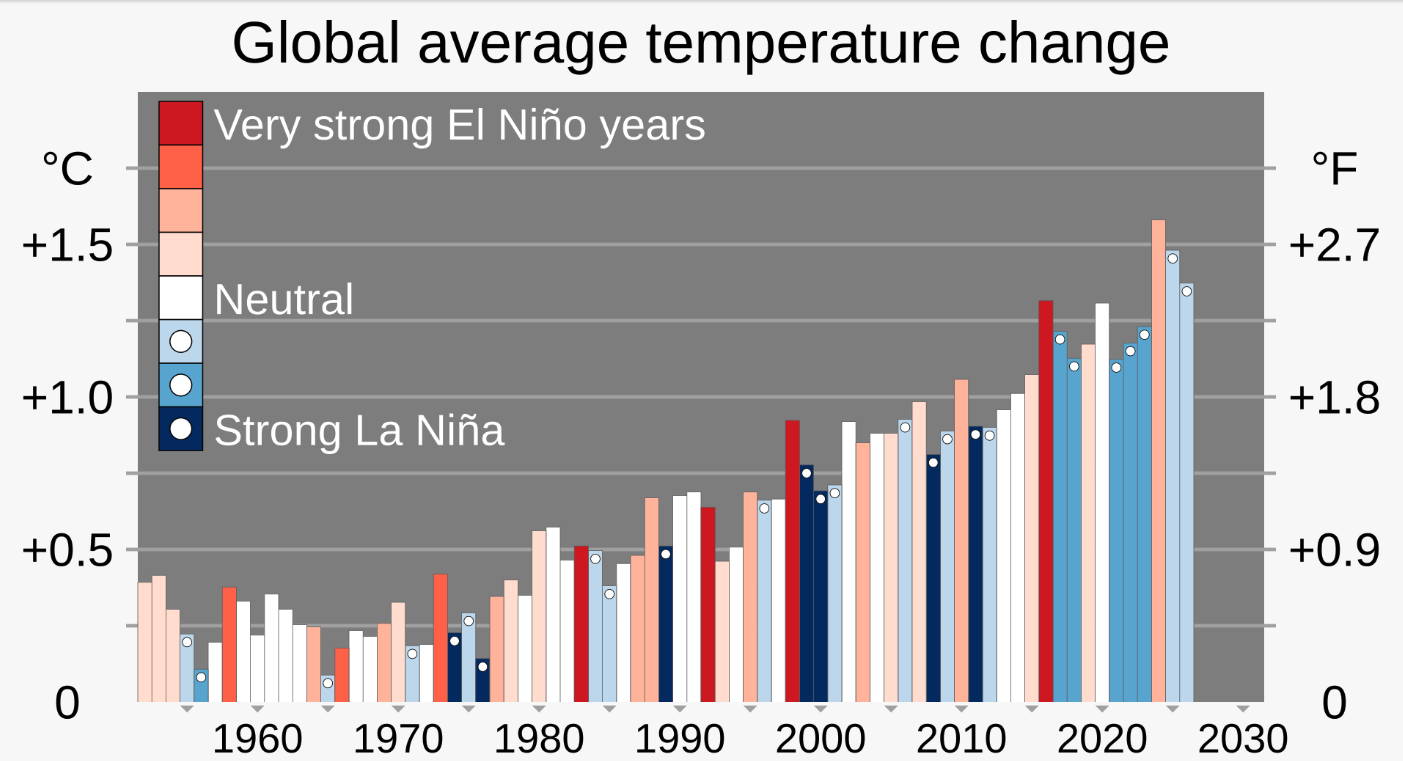
Illustration Credit: Wikipedia Creative Commons License
The 2023–2024 El Niño event was rated "strong", and contributed to a record-breaking global average surface temperature for the July 2023 to June 2024 time period.
Diagram By RCraig09 - Own work, CC BY-SA 4.0, https://commons.wikimedia.org/w/index.php?curid=109388602
The developing 2026–27 El Niño is strengthening rapidly and could become one of the most powerful events in the modern observational record.
In regions facing hotter, drier conditions—such as western North America, Australia, and parts of South America—firefighters may confront longer wildfire seasons, faster fire spread, and more frequent interface evacuations, all while working in dangerous heat‑stress environments.
The U.S. National Oceanic and Atmospheric Administration (NOAA) says there is now a greater than 90 percent chance that El Niño will become a very strong event during the Northern Hemisphere autumn and winter of 2026–27.
Climate Change May Increase the Consequences
El Niño is a natural part of the Earth's climate system, but it is now occurring in a world with significantly warmer oceans and higher average global temperatures.
This means that El Niño-related heat, rainfall and drought can occur on top of an already warmer climate.
Climate change does not mean that every extreme event can be attributed to El Niño. Nor can every El Niño-related disaster be attributed entirely to climate change.
Instead, the two factors can interact:
A natural climate pattern that raises the likelihood of drought, heavy rain or extreme heat can produce more damaging consequences when the effect of climate change is already present and the background temperatures are already higher and atmospheric moisture levels are greater.
A Major Test for Global Preparedness
With NOAA now forecasting a greater than 90 percent probability of a very strong El Niño, governments and emergency services have an opportunity to prepare before the event reaches its expected peak.
The risks will vary sharply from one region to another.
Some areas should prepare for drought and water shortages. Others face increased risks of flooding, landslides and severe storms. Agricultural agencies, water managers, fire services, health authorities and energy providers may all face different challenges.
The key message from forecasters is therefore not that every predicted impact is inevitable.
Rather, the probability of many historically recognized El Niño impacts is increasing—and preparations can be targeted toward regions where the risks are highest.
As the 2026–27 El Niño continues to develop, regional forecasts will become increasingly important for determining where the most serious impacts are likely to occur.
Conversely, areas expecting heavy El Niño rainfall, including California, the U.S. South, and parts of South America, face flood‑driven rescue operations, landslides, and infrastructure failures that strain already stretched emergency services. Fire chiefs note that rapid swings between drought and deluge can degrade soils, weaken slopes, and create volatile post‑fire landscapes, increasing the risk of debris flows and secondary disasters. Combined with global warming, the 2026–27 El Niño is expected to produce more complex, multi‑hazard incidents, demanding greater staffing, interagency coordination, and resilience planning across the fire‑service sector.
Sea-surface temperatures in the eastern equatorial Pacific have already risen more than 2°C above average, while unusually warm water below the surface has intensified. NOAA's August outlook estimated a 69 percent chance that the October–December 2026 period could reach a historic intensity exceeding previous El Niño events in records dating back to 1950.
The World Meteorological Organization has likewise warned that the developing El Niño is likely to significantly influence global temperatures and rainfall patterns, increasing the risk of drought, flooding, heatwaves and other extreme weather in different parts of the world.
However, forecasters stress that a strong El Niño does not guarantee that every region will experience its typical historical impacts. Local weather patterns are also influenced by other climate systems and short-term atmospheric conditions.
What Is El Niño?
El Niño is a naturally occurring climate phenomenon involving unusually warm ocean temperatures across parts of the central and eastern equatorial Pacific.
The warming alters atmospheric circulation and can shift major rainfall and temperature patterns around the world.
Its effects can be particularly significant in countries bordering the Pacific, but changes in atmospheric circulation can also influence weather in North America, South America, Africa, Asia and Australia.
The precise impacts vary between El Niño events, but a sufficiently strong event generally increases the likelihood of recognizable regional patterns.
North America: Wetter Conditions in the South, Variable Effects Elsewhere.
Southwestern United States
A strong El Niño typically increases the probability of wetter-than-normal conditions across parts of the southern United States during the Northern Hemisphere winter.
This can include increased risks of:
- Heavy rainfall
- River and urban flooding
- Landslides in vulnerable terrain
- Coastal erosion
- High surf and damaging winter storms
Southern California and other parts of the southwestern United States may be particularly vulnerable to flooding, especially in areas affected by recent wildfires where vegetation loss can increase the risk of mudslides and debris flows.
However, El Niño does not guarantee continuous heavy rain. The timing and location of individual storms remain difficult to predict months in advance.
Northern United States and Canada
The impacts of El Niño across northern North America are generally less uniform.
Some regions may experience warmer-than-average winter conditions, while changes in snowpack, storm tracks and precipitation can vary substantially.
For Canada, the effects of El Niño depend heavily on region and season. A strong event can alter winter temperatures and precipitation patterns, but it should not automatically be interpreted as a forecast of drought, reduced snowfall or wildfire conditions across the entire country.
Central America and the Caribbean: Increased Drought Risk
Forecasts associated with the strengthening 2026 El Niño indicate an increased likelihood of below-normal rainfall across parts of Central America and the Caribbean.
This could increase pressure on:
- Drinking-water supplies
- Agriculture
- Hydropower production
- River transport
- Food production
Drought can be particularly serious in areas where agriculture depends heavily on seasonal rainfall.
Water shortages may also have consequences beyond agriculture, affecting electricity generation in countries dependent on hydropower.
Not every country or region will experience drought at the same intensity, and the evolution of local rainy seasons remains an important factor.
South America: Flood Risk on the Pacific Coast, Drought Risks Elsewhere
Strong El Niño events can significantly increase the risk of heavy rainfall and flooding along parts of the Pacific coast of South America.
Peru has already identified large populations and numerous vulnerable areas as potentially at risk from flooding and mudslides as El Niño strengthens.
Heavy rainfall can trigger:
- Flash flooding
- Landslides
- Mudslides
- Damage to roads and bridges
- Disruption of agriculture
- Damage to homes and critical infrastructure
Northern and coastal regions can be particularly vulnerable when unusually warm Pacific waters increase evaporation and atmospheric moisture.
At the same time, other parts of Peru, including areas of the southern Andes, can face water shortages or drought conditions.
Australia and Southeast Asia: Greater Risk of Heat and Drought
The World Meteorological Organization's seasonal outlook indicates an increased likelihood of below-normal rainfall across much of Australia as El Niño strengthens.
For Australia, this can increase the risk of:
- Drought
- Water shortages
- Agricultural stress
- Heatwaves
- Dangerous fire weather
El Niño does not directly ignite wildfires, but prolonged hot and dry conditions can dry vegetation and increase the likelihood that fires will spread rapidly once ignited.
The precise wildfire outcome will depend on rainfall, temperatures, wind conditions, vegetation and ignition sources.
Indonesia and Maritime Southeast Asia
NOAA has already observed suppressed rainfall over Indonesia, a pattern consistent with a strengthening El Niño.
Prolonged rainfall deficits could increase risks to:
- Agriculture
- Water supplies
- Forest ecosystems
- Peatlands
- Air quality
Indonesia is particularly vulnerable to severe haze episodes when drought dries peatlands and forests, making fires more likely and allowing smoke to spread across national borders.
South Asia: Pressure on the Indian Monsoon
El Niño is often associated with a weaker-than-normal Indian summer monsoon, although the relationship is not absolute and individual monsoon seasons can be influenced by other climate systems.
India's Meteorological Department has warned of below-average rainfall in September 2026, following rainfall deficits earlier in the monsoon season.
Reduced rainfall can threaten:
- Rice production
- Cotton and soybean crops
- Corn and pulses
- Soil moisture
- Water supplies
- Hydropower production
Because a large share of Indian agriculture remains dependent on rainfall, significant monsoon deficits can have consequences for food prices and rural economies.
However, it would be premature to assign a precise percentage loss to India's economic growth solely because of El Niño.
Greater Horn of Africa
The WMO's seasonal outlook indicates an increased probability of below-normal rainfall across parts of the Greater Horn of Africa.
This could increase concerns about:
- Drought
- Crop losses
- Water shortages
- Livestock losses
- Food insecurity
The region remains particularly vulnerable because many communities depend directly on seasonal rainfall and pastoral agriculture.
West Africa and the Gulf of Guinea
In contrast, parts of the northern Gulf of Guinea may have an increased likelihood of above-normal rainfall.
This means that different parts of Africa could simultaneously face drought and flooding.
The regional contrast highlights why broad statements that El Niño simply causes “drought in Africa” are misleading.
Pacific Islands: Extreme Weather and Marine Ecosystem Risks
The Pacific Islands may face some of the most direct consequences of exceptionally warm Pacific waters.
Possible impacts include:
- Marine heatwaves
- Coral bleaching
- Fisheries disruption
- Drought on some islands
- Heavy rainfall and flooding elsewhere
Small island states are especially vulnerable because relatively small changes in rainfall can rapidly affect freshwater supplies.
Marine ecosystems can also be severely affected when unusually warm water persists for long periods.
Europe: Less Direct but Still Potentially Affected
El Niño's influence on Europe is generally weaker and less predictable than its influence on regions surrounding the Pacific.
It would therefore be inaccurate to claim that El Niño will directly cause specific European heatwaves, droughts or floods.
However, a strong El Niño can contribute to changes in global atmospheric circulation and can affect global temperatures. Individual European extreme-weather events are influenced by many additional factors, including North Atlantic conditions, atmospheric blocking patterns and long-term climate change.
Europe should therefore be described as potentially influenced by the broader global climate effects of El Niño, rather than being assigned a simple “El Niño forecast.”
Global Food, Energy and Economic Risks
The most important global consequence may be the simultaneous pressure placed on several climate-sensitive sectors.
Potential impacts include:
- Reduced agricultural production in drought-affected regions
- Flood damage to crops and infrastructure
- Disruption of fisheries
- Reduced hydropower production where water levels fall
- Increased electricity demand during heatwaves
- Higher food prices
- Disruption to transport and supply chains
The scale of the economic consequences remains uncertain.
Past strong El Niño events have caused significant global economic damage, but it is not scientifically sound to assign a precise economic cost to the 2026–27 event before its full impacts are known.
Futher Reading:
https://www.cpc.ncep.noaa.gov/products/analysis_monitoring/enso_disc_aug2026/ensodisc.pdf?
https://www.cpc.ncep.noaa.gov/products/analysis_monitoring/enso_disc_dec2025/ensodisc.shtml
https://www.cbc.ca/news/climate/el-nino-2026-extreme-weather-9.7313170?
https://www.aol.com/articles/super-el-ni-o-could-090502000.html?