
EU Summit Urges Shift to Integrated Wildfire Risk Management
Thank you for choosing Automatic Translation. Currently we are offering translations from English into French and German, with more translation languages to be added in the near future. Please be aware that these translations are generated by a third party AI software service. While we have found that the translations are mostly correct, they may not be perfect in every case. To ensure the information you read is correct, please refer to the original article in English. If you find an error in a translation which you would like to bring to our attention, it would help us greatly if you let us know. We can correct any text or section, once we are aware of it. Please do not hesitate to contact our webmaster to let us know of any translation errors.
Summary Report – High-Level Roundtable on Integrated Wildfire Risk Management
Brussels, 30 January 2026
Purpose and Context
This high-level roundtable brought together European, national, and regional stakeholders from diverse backgrounds and sectors to provide strategic input to the upcoming European Commission Communication on Integrated Wildfire Risk Management.
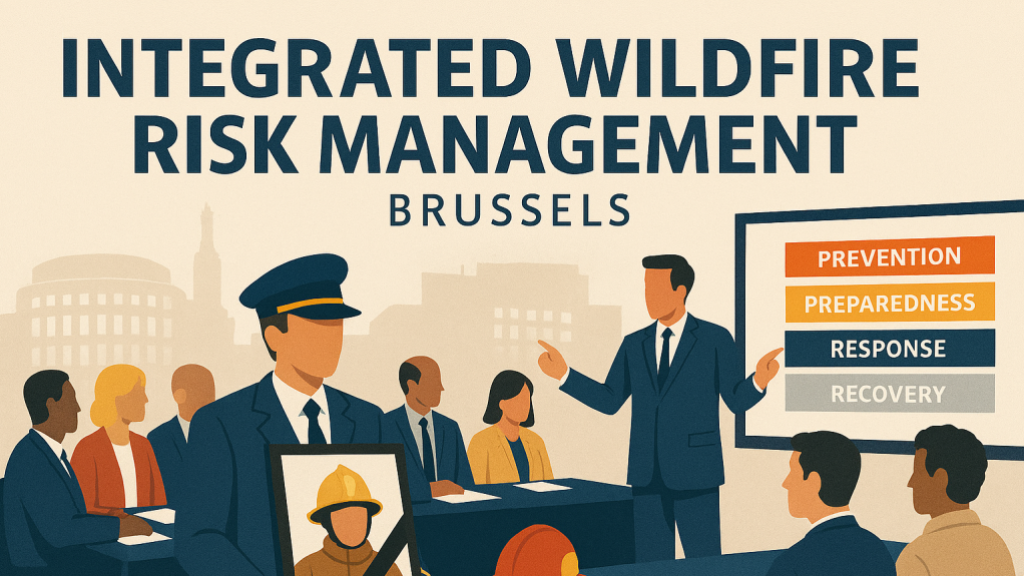
The discussion, in which CTIF was represented by Tom Van Esbroeck (Belgium), addressed wildfire risk across the full disaster risk management cycle, i.e. prevention, preparedness, response and recovery. It put a strong emphasis on breaking policy silos, strengthening prevention, and aligning environmental, land-use and civil protection policies. This report summarizes the discussion, which focused on the three core guiding questions below.
How can the EU build a truly holistic approach to wildfires integrating prevention, preparedness, response and recovery across policy areas?
Participants underlined that wildfires represent an increasing risk that partly already overwhelms national responders today and are projected to grow further in the next years. They strongly concurred on the need for a paradigm shift from a response-driven model towards integrated, wildfire risk management that places due emphasis on prevention. Wildfires were consistently framed not only as emergency events, but as climate-driven, societal and territorial risks, requiring coordinated action across multiple policy domains and authorities within the rationale of the EU Preparedness Strategy’s whole-of-government and whole-of-society approach.
A holistic EU approach should be grounded in healthy, actively managed landscapes as the first line of defence. Participants highlighted the role of sustainable forest management, grazing, diversified land use, fuel management, and spatial planning in reducing fire intensity and exposure. Fire-resilient landscapes were also recognised for their co-benefits for biodiversity, water protection, health, bioeconomy and rural vitality.
Governance emerged as a critical enabling factor. Many contributors stressed the need for integrated governance models that systematically connect environmental, agricultural, land-use and civil protection authorities. The EU was seen as having a key role in providing a shared strategic narrative, common principles and guidance, while allowing solutions to be tailored to diverse regional ecological and socio-economic contexts.
Communities and citizens were repeatedly identified as essential actors for both ignition of fires and as first responders. Empowering local authorities, land managers, farmers, volunteers, and residents through education, awareness, participatory risk planning and incentives was seen as central to building resilience. Several speakers underlined that fire risk is largely human-driven, and that behaviour, exposure, and vulnerability must be addressed alongside technical solutions.
At EU level, existing instruments, such as preparedness and response arrangements under the Union Civil Protection Mechanism, data platforms such as European Forest Fire Information System, training, early warning systems and research initiatives, were recognised as valuable foundations and requested to be further strengthened. However, participants called for stronger integration of these tools within the entire risk management cycle, emphasizing that investments in suppression must go hand in hand with prevention.
What key changes are needed in specific sectors over the next five years?
Across sectors, participants emphasised the need for investment into prevention and preparedness.
In land use, forestry and agriculture, key changes include embedding wildfire prevention objectives into legislation and funding frameworks, addressing land abandonment, and making land and forest management economically viable. Farmers, forest owners and local communities were highlighted as indispensable partners, given their role in landscape management and their frequent position as first responders. Aligning environmental ambition with practical fuel management was seen as essential.
In civil protection and emergency response, participants acknowledged major progress at EU level but warned that response systems are increasingly overwhelmed by simultaneous and extreme events. Under an integrated approach, strengthening of wildfire response capacities, including under rescEU and via the pre-positioning of firefighters in high-risk areas, must go hand in hand with reinforced and better coordinated prevention, post-fire analysis and learning, improved early detection, access to water resources, and training and exchange to support mutual learning from good practices.
In governance and planning, participants called for EU level guidance, best-practice exchange, locally defined targets and indicators, and more flexible funding instruments that allow long-term, place-based prevention measures. Local and regional authorities were identified as pivotal actors across the entire cycle, requiring stronger support.
In education, research and data, participants stressed that knowledge already exists but is insufficiently scaled or operationalised. Data held by different actors, including insurers, could be better integrated to improve risk assessment and decision-making. Training young people and offering them learning and exchanges opportunity were identified as key avenues to build capacities.
The use of technology, including AI, can also support the different phases of the wildfires management cycle.
What are the main obstacles preventing sectors from collaborating effectively on wildfire risk management?
The discussion identified fragmentation as the dominant barrier, across responsibilities, funding streams, and legal frameworks. Policy silos between environment, agriculture, land use and civil protection further hinder a holistic approach. Short-term funding cycles and crisis-driven political priorities limit sustained investment in prevention and thereby their effectivity. Moreover, participants stressed the lack of a status and release arrangements for volunteers which hinders the possibility for spontaneous volunteering in emergencies.
Concluding Observations
The roundtable revealed a strong convergence around the need for an integrated European approach to wildfire risk management, incorporating the whole disaster risk management cycle prevention, preparedness, response and restoration / recovery. Participants broadly agreed that the EU should act as an enabling umbrella, providing strategic direction, incentives and coherence, while respecting regional diversity and local leadership.
The discussion marked the beginning of an ongoing policy dialogue. Continued engagement, learning and cooperation across sectors and levels of governance were seen as essential to meet the growing wildfire challenge facing Europe.
Photo Credit: Executed by Microsoft Co-Pilot from a prompt by Bjorn Ulfsson.
List of participants
List of confirmed participants (17)
EU institutions/bodies
-
Mr. Francesco CARTERI, Member of Cabinet of the President, European Committee of the Regions
-
Mr. Stoyan TCHOUKANOV, President of the NAT section, European Economic and Social Committee
-
Mr. MEP Gregory ALLIONE, Group Renew Europe (France), ENVI Committee member of the European Parliament
Member States
-
Mr. Dr. Tiago M. OLIVEIRA, Chairman of the Board of Directors of the Integrated Rural Fire Management Agency, Portugal
-
Mr. Prof. George BOUSTRAS, Special Advisor on civil protection and crisis management to the President of the Republic of Cyprus; UNESCO Chair of Disaster Risk Reduction and Societal Safety in SE Mediterranean, European University, Cyprus
-
Mr. Luigi D’ANGELO, Director of the Emergency Management Office, Civil Protection Department, Italy
-
Mr. BG Roman HLINOVSKÝ, International Cooperation, DG Fire Rescue Service of the Czech Republic
Regions
- Mr. Antoni TRASOBARES RODRIGUEZ, Director, CTFC Institute (Science for Forest Management, Biodiversity & Bioeconomy), Government of Catalunya, Spain
First responders
- Mr. Kolonel Tom VAN ESBROECK, CTIF (International Association of Fire and Rescue Services), Belgium
Science community
-
Ms Dr Claudia BERCHTOLD, Coordinator Sustainable Transformation & Risk Reduction, Fraunhofer Institute for Communication, Information Processing and Ergonomics (FKIE), Germany
-
Ms Prof Cathelijne STOOF, Scientific Director PyroLife Innovative Training Network, Wageningen University, The Netherlands
Landowners
-
Mr. António Paula SOARES, Vice-President, CEPF (Confederation of European Forest Owners)
-
Mr. Javier EZQUERRA BOTICARIO, Services coordinator at the Directorate General of Natural Heritage and Forest Policy, Government of Castilla y León, Spain, member of EUSTAFOR (European State Forest Association)
-
Ms Elli TSIFOROU, Secretary-General, COPA-COGECA
NGOs
-
Ms Gabriella CIVICO, Director, Centre for European Volunteering.
Insurance companies
-
Mr. Nicolas JEANMART, Insurance Europe
International organisations/UN
- Mr. Sebastien PENZINI, Deputy Chief of the Regional office for Europe and Central Asia, UNDRR (United Nations Office for Disaster Risk Reduction)