
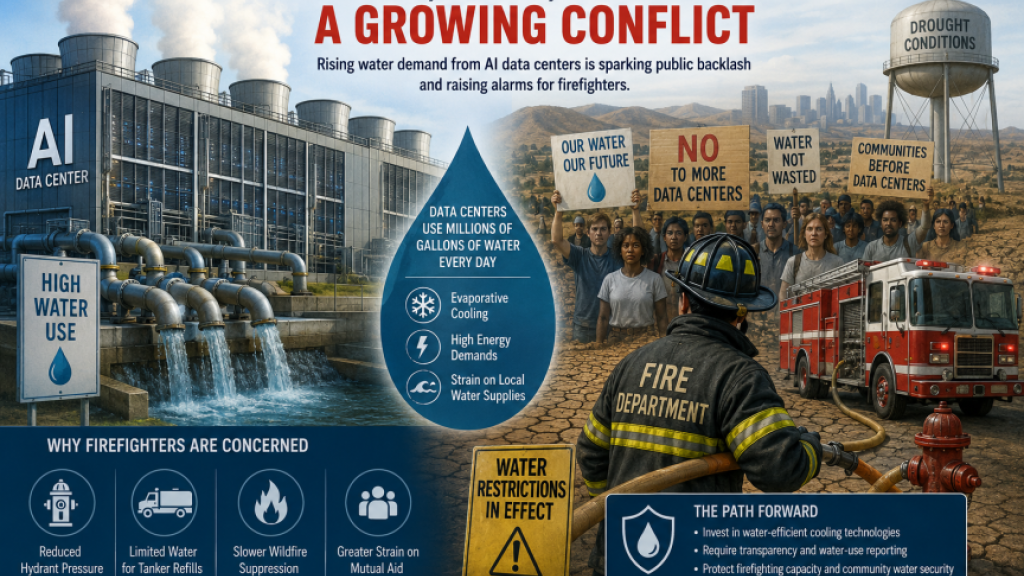
AI data centers face growing backlash from firefighters and the public over heavy water use
Merci d'avoir choisi Automatic Translation. Nous proposons actuellement des traductions de l'anglais vers le français et l'allemand. D'autres langues de traduction seront ajoutées dans un avenir proche. Veuillez noter que ces traductions sont générées par un service logiciel d'IA tiers. Bien que nous ayons constaté que les traductions sont généralement correctes, elles peuvent ne pas être parfaites dans tous les cas. Pour vous assurer que les informations que vous lisez sont correctes, veuillez vous référer à l'article original en anglais. Si vous trouvez une erreur dans une traduction que vous souhaitez porter à notre attention, il nous serait très utile que vous nous en fassiez part. Nous pouvons corriger n'importe quel texte ou section, dès que nous en avons connaissance. N'hésitez pas à contacter notre webmaster pour nous faire part de toute erreur de traduction.
AI centres are forecasted to need massive amounts of water for cooling. In several regions, fire‑service leaders have publicly warned that water‑use restrictions tied to AI data‑center growth could compromise firefighting operations.
Public opposition to AI data centres is mounting across North America, Australia and Europe as new research and community protests highlight the enormous volumes of water required to cool the facilities powering artificial‑intelligence systems.
Information is also circulating on the internet about firefighters raising concerns about water use in AI centres, however these statements are AI generated and currently not verified by CTIF.
Analysts say the surge in AI model training and deployment has driven a parallel boom in hyperscale data‑center construction, many of which rely on evaporative cooling systems that consume large amounts of freshwater. The United Nations University warns that AI’s environmental footprint extends far beyond electricity, with significant water and land impacts tied to the energy used to run and cool data‑center infrastructure.
In the Australia, Europe, United States and Canada, residents have staged protests against proposed AI data‑center projects, citing concerns about water withdrawals during periods of drought and municipal restrictions.
A recent analysis by Chatham House reports that AI‑driven data‑center growth is becoming a fast‑rising driver of water demand, especially in regions already facing climate‑related water stress. The think tank notes that some communities now say they would prefer a nuclear power plant over a data center, reflecting the scale of public concern.
Governments are beginning to respond. The UK, which has announced plans for roughly 100 new data centers by the early 2030s, is being urged to adopt stricter transparency and sustainability requirements to prevent water‑use conflicts. Researchers warn that without clear governance, the environmental burdens of AI infrastructure — including water withdrawals, land use, and energy demand — will fall disproportionately on vulnerable communities.
As AI adoption accelerates, policymakers and industry leaders face growing pressure to develop water‑efficient cooling technologies, disclose water‑use data, and ensure that the benefits of AI do not come at the expense of local water security.
Why AI data centres use so much water
AI data centres consume water primarily for cooling. Some of that water can be recycled, but not nearly as much as people assume. The hotter the chips, the more cooling they need — and AI chips (GPUs/TPUs) run far hotter than traditional cloud servers.
The main reasons:
• AI workloads generate extreme heat
Training and running large AI models uses:
- thousands of GPUs
- operating at very high power density
- producing enormous heat loads
This heat must be removed continuously.
Can the water be recycled?
Partially — but not fully.
Why not?
Evaporative cooling works by turning water into vapour.
Once evaporated:
- it cannot be recaptured
- it cannot be reused
- it leaves the system entirely
This is why evaporative cooling is so water‑intensive.
Many AI data centres are built in:
- dry regions (U.S. West, Spain, Australia)
- cheap‑power regions (Ireland, Netherlands)
- places with limited water reserves
This amplifies the impact.
Illustration Credit: Illustration created by Chat GPT from a prompt by Bjorn Ulfsson, CTIF. AI-generated... So yes, guilty as charged...
Further Reading:
https://www.chathamhouse.org/2026/06/ai-water-usage-requires-governments-rethin…?
https://www.abc.net.au/news/2026-06-09/firefighter-concern-over-data-centres-in…
https://www.kktv.com/2026/06/10/experts-weigh-largest-environmental-impacts-dat…
https://truthout.org/articles/while-los-angeles-burns-ai-fans-the-flames/
https://www.nytimes.com/2026/03/14/us/rock-fire-department-google-donation-oklahoma.html
https://www.vpm.org/news/2026-05-05/wunc-data-center-opposition-political-chall…