
Global CTIF survey shows women firefighters want fair, inclusive and modernized updates to physical tests
感谢您选择 Automatic Translation。目前,我们提供从英语到法语和德语的翻译,不久的将来还会增加更多翻译语言。请注意,这些翻译是由第三方人工智能软件服务生成的。虽然我们发现这些翻译大部分都是正确的,但并非每种情况下都完美无缺。为确保您阅读的信息正确无误,请参考英文原文。如果您发现翻译中有错误,希望引起我们的注意,请告诉我们,这将对我们大有帮助。我们一旦发现任何文字或章节有误,都会及时更正。如有任何翻译错误,请及时与我们的网站管理员联系。
 A Spanish reporter recently contacted CTIF to write a story about Women in Fire & Rescue around the world. In particular, she asked two questions about gender equality in fire and rescue services:
(1) whether physical entry tests differ for men and women, and
(2) what the Spanish representation in the CTIF Equality Commission emphasizes.
Responses from CTIF Commission for Women in Fire & Rescue members show wide international variation in physical testing standards:
-
These countries have the same tests for men and women: Sweden, UK, Ghana, Greece, Finland, Germany (though Germany’s representative argues this may disadvantage women), Denmark, Australia and New Zealand.
- These countries have different standards for men and women: Japan and South Korea, where entry‑level fitness benchmarks differ by sex, though operational duties are identical once hired.
Several representatives note that test design varies significantly between fire services within each country, and some departments have no formal tests at all. This especially applies to volunteer brigades.
Germany’s representative raises concerns that identical standards may unintentionally discriminate against women and argues for scientifically justified, realistic, regularly reviewed fitness tests. Denmark mentions recent adjustments to better include women.
Regarding Spain, no Spanish representative responded in the thread, so the group could not provide a definitive statement about Spain’s official position on equality within fire and rescue services.

Fair testing fitting the true nature of the work - not just raw strength
From the tone and content of their replies, most women in the group want fair, realistic, and inclusive physical testing — not necessarily easier standards, but ones that reflect the actual demands of firefighting rather than outdated strength benchmarks.
Here’s the essence of their shared perspective:
- 🔸 Equality with realism: Most participants support identical tests for men and women only if those tests are scientifically justified and directly relevant to real firefighting tasks.
- 🔸 Review and modernization: Several voices, especially from Germany and Denmark, call for regular review and redesign of tests to ensure they measure job‑specific ability rather than raw physical strength.
- 🔸 Inclusion and opportunity: Commission members emphasize that women should not be excluded by arbitrary physical criteria and that smaller or differently built firefighters can bring advantages — agility, endurance, efficiency in confined spaces.
- 🔸 Cultural shift: The underlying wish is for fire services to evolve beyond traditional assumptions about strength and gender, toward a system that values competence, training, and teamwork.
In short, they want testing that is fair, evidence‑based, and inclusive — not simply identical or “equal” on paper.
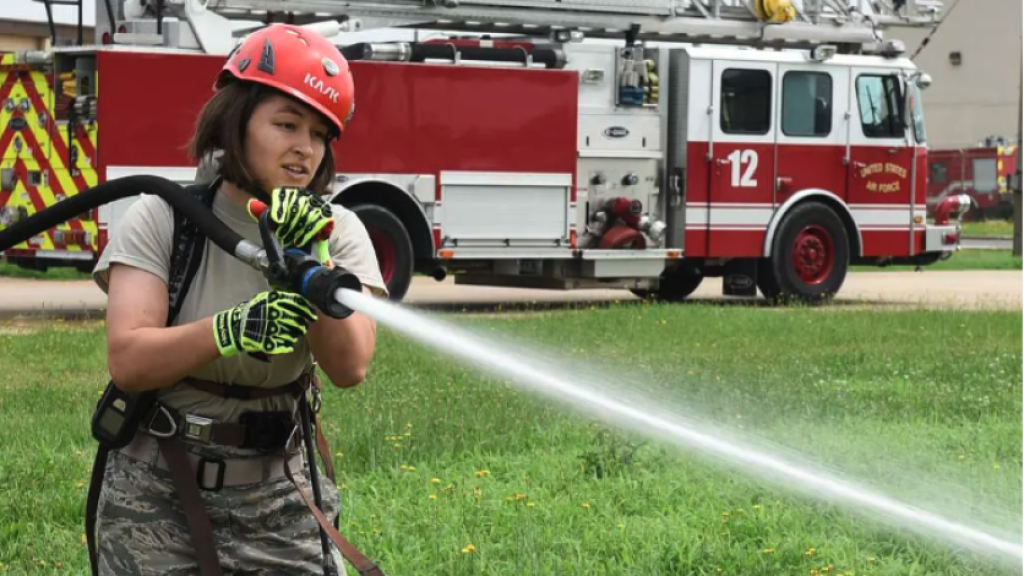
Illustration Credit: U.S. Air Force Academy Cadet 2nd Class Madison Tung sprays a fire hose during a fire training challenge at Kunsan Air Base, Republic of Korea, July 11, 2017. The visit was part of the Air Force Academy’s Operation Air Force program which allows cadets to travel different bases to learn about different careers and missions.
(U.S. Air Force photo by Senior Airman Michael Hunsaker/Released)
Some quotes form the members of the Commission for Women in Fire & Rescue:
Fuchuki, Japan:
"In Japan, the standards for basic fitness tests (such as grip strength, sit-ups, shuttle runs, and agility tests) often differ between men and women, depending on the local fire department. These differences reflect average physiological differences between the sexes. - However, once recruited, firefighters are generally expected to perform the same operational duties regardless of sex. Tasks such as carrying heavy equipment, deploying fire hoses, climbing ladders, and rescuing victims require the same level of job performance."
Similar ideas are echoed by Jeonghee Jin, South Korea:
"Like Japan, the Republic of Korea uses different physical fitness standards for male and female firefighter applicants. However, all firefighters are expected to perform the same duties once they are on the job. Therefore, there is occasional debate over whether a single physical fitness standard should be applied to everyone".
Kirsten Dyrvig, Denmark
"In Denmark there is no difference in tests for men and for women. But the test vary a lot for different Fire Services. Some don't have tests at all. For my Fire Service we have changed the tests a bit and put in variations to include women better".
Birgit Kill, Germany:
Birgit Kill argues that Germany’s uniform physical fitness tests for men and women in the fire service are problematic and potentially discriminatory.
"In almost all German fire services, too, no distinction is made between men and women in the physical fitness test. I consider this to be highly problematic. Whilst uniform requirements may seem fair at first glance, they can constitute discrimination on the grounds of gender. A female firefighter affected by this might need to have the matter reviewed by a legal expert".
She believes that while identical standards may appear fair, they ignore real physiological differences and could disadvantage women.
She also criticizes the system for being inconsistent and outdated — tests are usually required only at recruitment and rarely reassessed later, even though most German fire calls are handled by volunteer brigades who are only tested in respiratory mask fitness, not in physical fitness of the individual firefighter.
Her main message: fitness tests should reflect the actual demands of firefighting, be scientifically justified, and reviewed regularly to ensure fairness and realism. She calls for a shift away from rigid strength‑based measures toward a more nuanced understanding of performance, noting that smaller, well‑trained women can have advantages such as agility and lower air consumption.
"Things are different with the German police. There, the fitness test is broken down by gender. And all the test results are assessed together. In the fire service, we need more than just muscles 😏", she adds.
Basia, Poland:
"In Poland, physical fitness tests for candidates to the State Fire Service depend on the recruitment path. For administrative or non-operational posts, the tests are gender-differentiated: men perform pull-ups, while women perform a medicine-ball throw; both groups also take the envelope run and the beep test. However, for operational posts involving direct participation in rescue and firefighting activities, including fire-and-rescue units, women and men take the same set of tests: pull-ups, the envelope run and the beep test. The same general set is used in recruitment to fire service schools in candidate service, with an additional swimming test. Minimum final score thresholds may still differ between women and men."

The CTIF Commission for Women in Fire & Rescue Services during their August meeting in Basel, Switzerland 2024. Photo by the hosting company ROCHE.