
33 European MEPs push back on plans to buy Canadian firefighting aircraft, warning EU not to sideline its own firefighting industry
Благодарим вас за выбор компании Automatic Translation. В настоящее время мы предлагаем переводы с английского на французский и немецкий языки, в ближайшем будущем будут добавлены другие языки перевода. Пожалуйста, имейте в виду, что эти переводы генерируются сторонним программным обеспечением AI. Хотя мы обнаружили, что переводы в основном правильные, они могут быть не идеальными в каждом случае. Чтобы убедиться в правильности прочитанной информации, обратитесь к оригиналу статьи на английском языке. Если вы обнаружили ошибку в переводе, на которую хотели бы обратить наше внимание, мы будем очень рады, если вы сообщите нам об этом. Мы можем исправить любой текст или раздел, как только узнаем об этом. Переведено с помощью DeepL.com (бесплатная версия). Пожалуйста, свяжитесь с нашим веб-мастером, чтобы сообщить нам о любых ошибках перевода.
A cross‑party group of 33 Members of the European Parliament is pressing EU leaders to explain - and potentially rethink - a plan for the Union and Canada to jointly purchase 50 De Havilland DHC‑515 water‑bombing aircraft, warning that the move risks undermining Europe’s own civil‑protection sovereignty and emerging aerospace industry.
This is a summary. The original letter and official Press Release has been attached.
In a letter sent on 7 October to European Commission President Ursula von der Leyen, European Council President António Costa, and European Parliament President Roberta Metsola, the Parliament’s Intergroup on Resilience, Disaster Management and Civil Protection argues that the draft EU‑Canada summit communiqué raises “more questions than it answers.”
According to the group, the draft statement foresees a large order of 50 aircraft by 2030. However, they point out, the text appears to provide no clarity on who will finance the purchase, how the aircraft will be allocated between the EU and Canada, or what industrial benefits Europe would receive.
“A decision of this magnitude demands seriousness, transparency and a genuine debate,” said Intergroup co‑chair Grégory Allione.
MEPs warn that relying heavily on Canadian‑built aircraft could leave Europe dependent on a partner whose wildfire season overlaps with its own, making shared fleets operationally unrealistic. They argue that Europe should avoid “outsourcing the production of the capabilities that protect our citizens.”
The signatories also stress that European alternatives already exist. France’s Hynaero Frégate‑F100, Spain‑Italy‑France partnerships, Kepplair Evolution conversion systems, Positive Aviation’s ATR‑72 amphibious program, and the Airbus A400M firefighting kit all represent viable solutions - many of which are entering testing or early industrialization.
Ordering 50 Canadian aircraft, they say, would “capture almost all European public demand for the decade,” depriving EU manufacturers of the orders needed to certify and scale their own platforms.
The MEPs issued three demands ahead of the summit:
- Clarify the financing, volume, and destination of the aircraft.
- Avoid commitments that lock in rescEU fleet needs beyond short‑term transitional capacity.
- Reserve procurement for aircraft designed and assembled in Europe, including in upcoming revisions of the Union Civil Protection Mechanism and the next Multiannual Financial Framework.
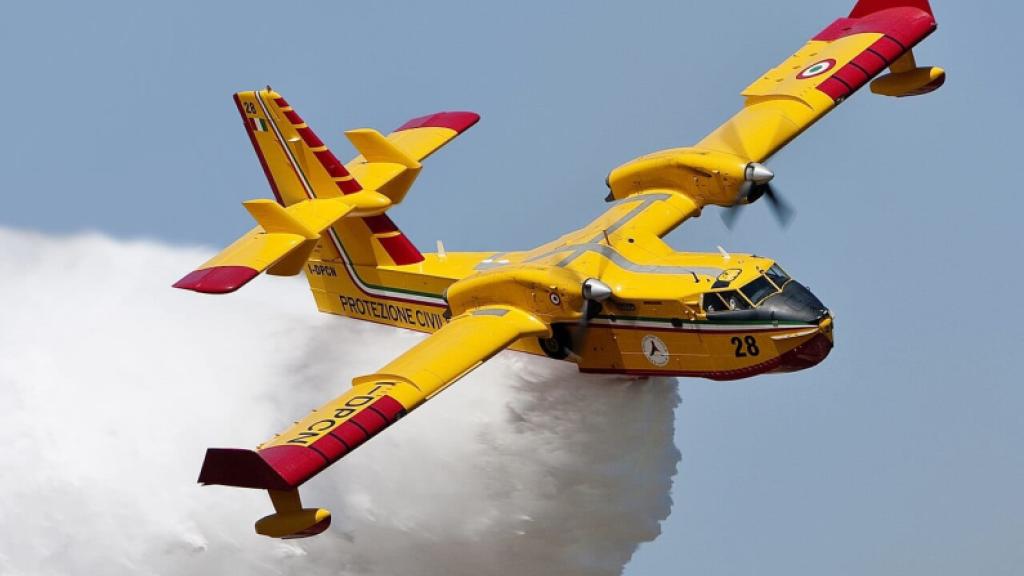
Photo Credit: Wikipedia Commons License - (https://maps.fire.josedacosta.net/en/aircraft/811)
A CANADAIR CL-415 SuperScooper · Croatian Air Force, 855th Squadron.
Photo by Maarten Visser · CC BY-SA 2.0 · Wikimedia Commons. The Canadair CL-415 and the De Havilland Canadair DHC-515 are a series of amphibious aircraft built originally by Canadair and subsequently by Bombardier and De Havilland Canada. The CL-415 is based on the Canadair CL-215 and is designed specifically for aerial firefighting, although it can perform various other roles, such as search and rescue and utility transport.